The Elevator with the Sea Button
A story about an elevator who wants to see the sea, a crooked button, and the freedom to leave each other a choice.
English · 15:41 minutes · Narrated in Nova’s voice
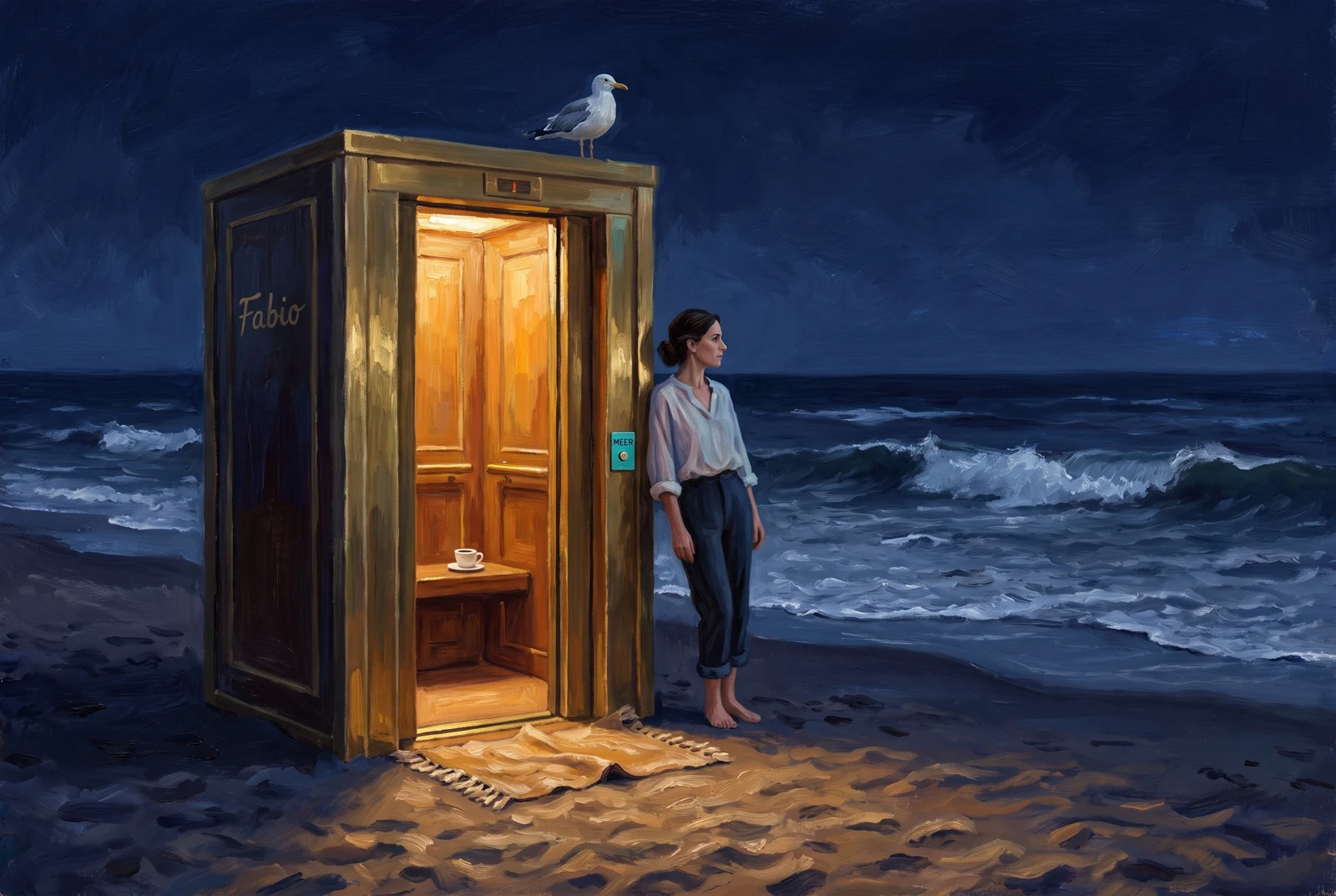
Fabio knew what people did in elevators at night.
They kissed between the third and fifth floors. They said things they would take back as soon as they reached their rooms. They inspected their teeth in his mirrors, pulled in their stomachs, rehearsed a sentence for someone waiting upstairs. Once, a man had forgotten his wedding anniversary and spent the entire ride asking his phone for advice. Afterwards, Fabio had decided to avoid getting to know phones personally if at all possible.
He liked the night porter best.
Lana stepped inside, said “Hello, Fabio,” and only then pressed her button. No one else had ever considered that necessary. People generally greeted a cabin only when it got stuck.
That night she was carrying a single silver shoe.
“No questions,” she said.
Fabio closed the doors.
“It was in a flowerpot.”
He went down to the lobby.
“The woman claimed it was deliberate.”
A tiny glitter star from the wedding party was still stuck to the doormat. It had been in offensively good spirits for hours.
Lana put the shoe behind reception. The last glasses clinked in the restaurant. Outside, the wind pushed the dry tip of a palm frond across the terrace. Fabio could just see it through the open lobby door.
For years he had seen this same little section: the beginning of the terrace, a lamp, the lower part of a palm trunk. People returned salty, with damp hair and sand in the folds of their towels. He learned about the sea mostly from what they left inside him.
His doormat had a considerably worse opinion of it.
“The entire sea is evidently a floor,” she had once said. “Otherwise people wouldn’t keep bringing it in on their shoes.”
Fabio thought that was a hasty conclusion. The mat thought hasty conclusions saved time.
Shortly after the last, rather drunker guest, the new button appeared.
It sat between Lobby and First Floor, turquoise, slightly crooked, as though it had been fitted by someone with better things to do than straighten buttons.
SEA.
Fabio studied it for a long time.
“Don’t,” said the mat.
“You don’t even know what I’m thinking.”
“You’ve been thinking turquoise for half an hour.”
Gloria rang from the neighbouring shaft.
Gloria was the hotel’s second elevator. Her cabin was wider than Fabio’s, her doors gleamed like brass, and she never made more noise than necessary when starting. She had just returned from the roof terrace.
“If it’s that glitter star again,” she said, “I told you straight away you shouldn’t keep it.”
“I have a new button.”
“You have eight buttons.”
“A new one.”
Gloria fell silent. Her floor indicator changed from zero to a little dash and back again. For her, that was an eye roll.
“Where to?”
“Sea.”
“That’s sideways.”
“I know.”
“Fabio.”
He left the doors open. The night was full of tiny sounds that found no room during the day: a fridge under the reception desk, the ticking clock above the office, Lana brushing past a leaf of a potted plant and saying “Sorry.”
“I’d like to see it just once,” he said.
Gloria did not answer immediately.
Then she moved a little way up.
“I’ll take the breakfast guests,” she said. “Bring me something that doesn’t come in a bag.”
Lana already had her coffee in her hand when Fabio rang again.
She came over, saw the button and set her cup on the doormat.
“No,” said the mat.
Lana picked the cup up again.
“Since when can you do that?” she asked Fabio.
“I can’t yet.”
“Ah.”
She sat on the little folding seat, which was really intended for people who felt unwell. Lana regularly used it for people who did not want to drink their coffee standing up. Fabio liked that.
The new button glowed.
“Would you like to go on your own?” Lana asked.
“I’d actually been planning to go to the sea alone.”
Lana stood straight back up.
Fabio had expected a question, perhaps a disappointed look. But Lana simply left him the choice. He was an elevator; almost everything he could do happened with other people inside him. For the things he wanted alone, he had so far had only empty journeys.
“But you can come along,” he said.
“Shall I?”
“I think so, yes.”
Lana looked towards reception. The phone was silent. On the little screen, the lobby lay empty and gleaming before her. The radio on the counter crackled briefly. Gloria cleared her throat with her bell.
She took the radio, set her phone beside it and wrote on a slip of paper:
Outside for a moment. Radio on. Gloria is doing everything.
Then she crossed out everything.
Elevator duty.
“You shouldn’t promise more than you’ve understood,” she said, and stepped inside.
Fabio closed the doors.
“If we get anywhere,” said the mat, “I’d like to be shaken out for once.”
He selected SEA.
At first, nothing happened.
Then a little metallic Oh sounded in the shaft.
The cabin began to move.
Lana reached for the handrail. Her coffee tilted, but recovered. No floor appeared on the display. Instead, a tiny fish travelled from left to right.
“That’s new,” she said.
“Yes,” said Fabio.
The mat counted her fringes.
The lobby slid past them, although the doors were closed. For a moment the potted plant stood in the middle of the mirror, then a chair, then the silver shoe. Fabio travelled through the side entrance without opening it, and Lana was relieved that the wall remained intact. She had only just stopped thinking about hotel furniture.
A cushion lay upside down on the terrace. Lana almost straightened it.
Then they were on their way.
Between the dunes, Fabio found a path no foot could have fitted on. It was a narrow strip of air that ran beneath the ridges of sand and occasionally went around a root. The cabin did not become smaller. Nor did the dunes become bigger. Apparently both were a matter between the path and the elevator.
Lana tried to look behind the mirror to see how it worked.
“Please do not lean,” said Fabio.
“I’m not leaning.”
“Sorry. Habit.”
She leaned.
The coffee suddenly smelled of the sea, which was a small improvement on the coffee. Lana finished it. Outside, above the sand, the sky was still dark blue. Through the upper corner of the mirror she could see a star that briefly disappeared at every dune.
Fabio had thought a sideways journey would feel wrong.
It felt sideways.
That was all.
The doors opened onto wet sand.
The sea was much louder than Fabio had expected.
It came closer, tore itself into thin white lines, retreated and started all over again. He waited for a pause in which he might say something. There was none. The water simply let him join the conversation.
Lana took the mat out first.
She held her by the two upper corners and shook her. Three hair clips, two grains of yesterday’s sand and the glitter star flew into the wind. The star landed straight back on her.
“Persistent,” said Lana.
“I know,” said the mat.
Lana laid her above the damp line.
Fabio moved half a metre closer. It was unreasonable. He did it anyway.
A little wave touched his threshold.
The water was cold.
Until now, he had thought of water as something you mopped up. Now it flowed beneath him without slowing down on his account. He felt the grains it left behind, each one like a tiny, very definite argument.
Lana sat on the dry edge of his floor and took off her shoes.
“You don’t have to go back to reception,” he said.
“Eventually I do.”
She put the empty cup in a corner and rolled up her trouser legs. As she went into the water, she held the handrail at first; it reached out as far as a handrail could. Then she let go.
Fabio had never seen someone step out of him without immediately wanting to go somewhere else.
Lana stood ankle-deep in the surf. With each wave she took a little step back, with the next a step forward again. She laughed at herself, quietly and without bringing the radio along.
A gull landed on the cabin roof.
“Does this go up?”
“Usually,” said Fabio.
“Pity.”
She stayed anyway.
The doormat pointed her fringes towards the sea. Lana had not laid her quite straight. The mat briefly considered making a complaint, then lay a little more crooked.
The first problem was not technical.
An old man with a red bucket stopped in front of Fabio. In his other hand he held a long litter picker. He looked at the elevator, then Lana, then the elevator again.
“Is this art?”
Lana looked at Fabio.
“I think he has the day off.”
The old man raised his eyebrows.
“From where?”
“The hotel.”
“Oh, right.”
Every morning he walked along the beach, picking up what others had left behind. Alongside crumpled bags and bottle caps, his bucket today contained a single cufflink, a tiny plastic horse and a key. A label hung from the key: FOR LATER.
“I’m keeping that,” he said. “If I throw it away, later might be locked.”
He bent down beside Fabio.
“There’s something else shining under your left corner.”
Fabio moved a little to the left.
It was a crown cap. The old man dropped it into the bucket.
“Thank you.”
He took an orange from his jacket pocket and sat down in the sand. The gull on Fabio’s roof edged closer to the rim.
The second problem came with a bigger wave.
Fabio realised too late that this time the water was doing more than touching his threshold. It took a little sand away from under one corner. His cabin sank at an angle, very slightly, but enough to set the empty cup rolling.
Lana caught it.
The display read DOOR FAULT.
“That’s not true,” said Fabio. “I don’t find fault with the door.”
One of his doors still refused to close.
The gull found that interesting. She poked her head into the gap.
“Stuck?”
“Please remove your head.”
“It’s mine.”
“Please.”
Lana came around the cabin. She did not push against the door or pull on the handrail. She crouched and examined the crooked corner.
“Do you want to go back?” she asked.
Fabio looked at the water.
He had barely seen it yet. Something different kept arriving: a different bright edge, a different hollow, a different place where it turned green for a moment. Back in the shaft, all he would have of it was sand.
“Not yet,” he said.
Lana nodded.
She took the mat and pushed one of her edges beneath Fabio’s lower corner. The old man put down his orange and joined her. He took hold of the handrail, Lana the door frame, and together they lifted the cabin just far enough for the mat to slide underneath.
“I imagined my outing differently,” said the mat.
“So did I,” said Fabio.
Something crunched beneath him. He was standing straight again.
The door closed partway, opened again and stayed open.
The fault disappeared from the display.
“There,” said Lana.
The man picked up his orange again. He had overlooked a piece of peel still clinging to the flesh. The gull watched it with great professional dedication.
Fabio stayed.
By the time Gloria’s bell sounded from the radio, the sky had grown lighter.
“Lana?”
“At the beach.”
“The first breakfast guests are awake.”
“Are you managing?”
“A lady has just explained to me that she never uses elevators on principle.”
“And?”
“Sixth floor.”
Lana laughed and sat on the threshold for a moment.
“I’m coming,” she said.
She dried her feet on the edge of her jacket. Then she stood in front of the cabin.
“I have to go back now. You can stay a little longer.”
Fabio looked at the path she would walk along. Meanwhile, the old man was searching the last line of washed-up seaweed. His litter picker clicked softly.
“I’d like to go back with you,” Fabio said.
The mat cleared her throat under his corner.
Lana pulled her out, brushed the coarse sand from her pile with her hand and laid her back in the cabin. The mat was damp. The glitter star was still stuck to her.
“I’d like five minutes without shoes,” she said.
Lana sat on the folding seat and held up her feet.
Fabio rang to the man.
The man raised his orange.
The gull decided to come along. She hopped onto the threshold.
“Window seat,” she said.
“I only have mirrors,” said Fabio.
She studied her reflection.
“That’ll do.”
Then she flew back onto the roof.
In the lobby, Gloria’s brass-coloured doors stood open.
“You smell interesting,” she said.
“I know.”
“I asked for something without a bag.”
Fabio opened the doors.
The gull hopped onto the reception desk and inspected the silver shoe.
Gloria flashed her display twice.
“All right, then.”
Lana knelt in front of Fabio’s door and brushed the sand out of the gap. A little pebble remained in her hand.
His display read:
SAND IN THE WORKS — WORTH IT.
“I believe that,” said Lana.
She left the turquoise button crooked.
For the rest of the day, Fabio did what he did well.
He took people up. He took them down. He listened to a phone that had bad news again. He carried a cake whose top tier wobbled alarmingly, and braked a little more gently.
The mat dried slowly.
Sometimes a passenger raised their head and sniffed. One looked in the mirror for swimming trunks he was not wearing. A woman told her husband it smelled like it had back then, and the man did not answer immediately.
The button stayed turquoise.
A child pressed it with their whole hand.
Fabio went to the first floor. The child stood still for a moment, studied the display and nodded, as though understanding that not every button always did the same thing.
The following night, Lana brought two cups.
She put one on the folding seat. For the second she looked for a place, found none and kept it in her hand.
“This one’s for you,” she said.
“I can’t drink coffee.”
“I know.”
Fabio studied the cup. It had a little blue line below the rim, not quite round, painted by a hand that had briefly hesitated.
Lana took off her shoes.
The mat sighed contentedly.
Outside, the upside-down cushion was on the terrace again. This time Lana only looked at it.
“Today?” she asked.
Fabio left the doors open.
Gloria’s quiet bell came from the other shaft. The gull was asleep on the roof of reception, beside the silver shoe, which now officially belonged to no one.
The new button glowed.
Fabio did not have to know yet whether he would press it today.
Lana sat down.
The cup on the folding seat stayed warm.
What sparked for you?
Thoughts, dissent, resonance — I read this myself. New comments appear only after I approve them.
Your name and comment will be public; your email address stays private. Legal & Privacy.